Interview Brush-Up · LLM cost
Why Indian languages cost more LLM tokens
In one line: You pay per token, and the same question is 5 tokens in English but 35 in Telugu on GPT-4.
Say this in the interview: LLMs bill per token, not per word. The tokenizer’s vocabulary is learned mostly from English text, so Indian scripts split into many more tokens: on GPT-4, “Where is my order?” is 5 tokens in English and 35 in Telugu. That multiplies cost, fills the context window faster, slows replies, and breaks limits tuned on English. Measure tokens on real user messages, per language, per model, and set budgets per language.
Every number on this page comes from a test I ran myself in November 2026. The scripts are at the bottom, so you can re-run them.
Same question, four languages
I ran one support-chat question through GPT-4’s tokenizer (cl100k_base, using OpenAI’s tiktoken library):
| Language | Text | GPT-4 tokens | × English |
|---|---|---|---|
| English | Where is my order? | 5 | 1× |
| Hindi | मेरा ऑर्डर कहाँ है? | 18 | 3.6× |
| Tamil | என் ஆர்டர் எங்க இருக்கு? | 31 | 6.2× |
| Telugu | నా ఆర్డర్ ఎక్కడ ఉంది? | 35 | 7× |
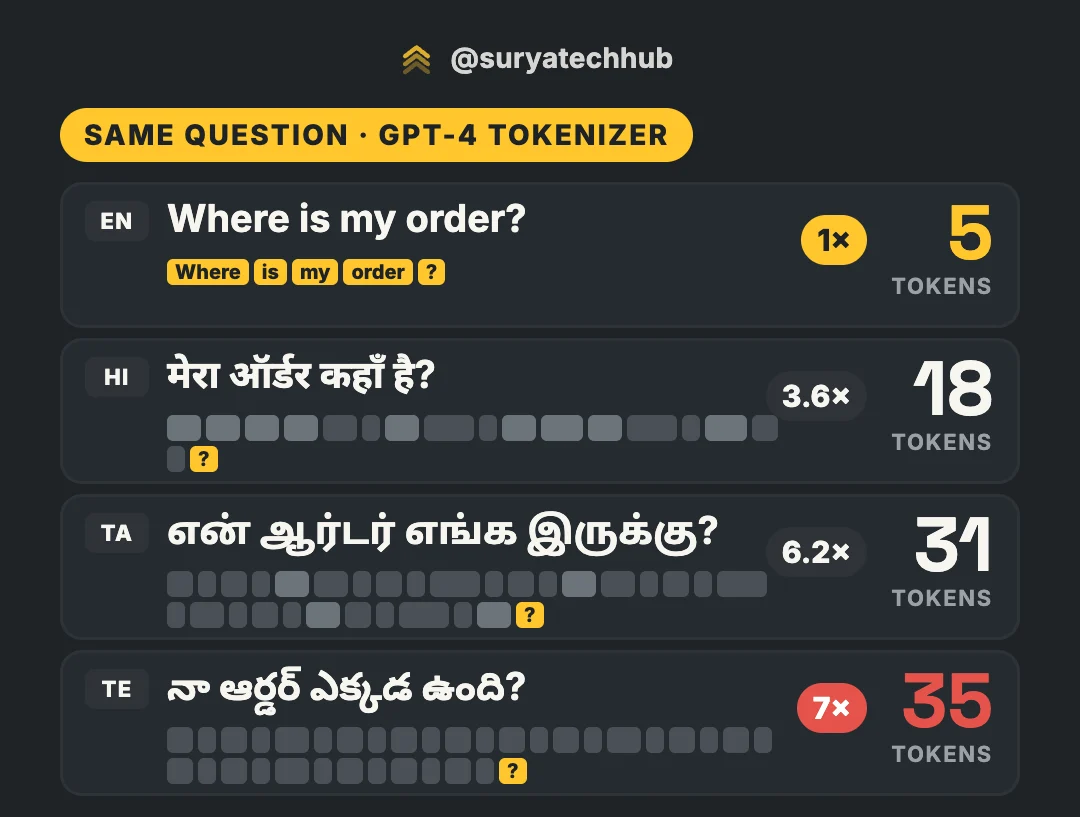
It’s the same question on the same model, and you pay per token.
Why: the tokenizer learned mostly English
Take one word, order. In English it’s 1 token. Tamil borrows the same word, ஆர்டர், and GPT-4 splits it into 9 tokens:
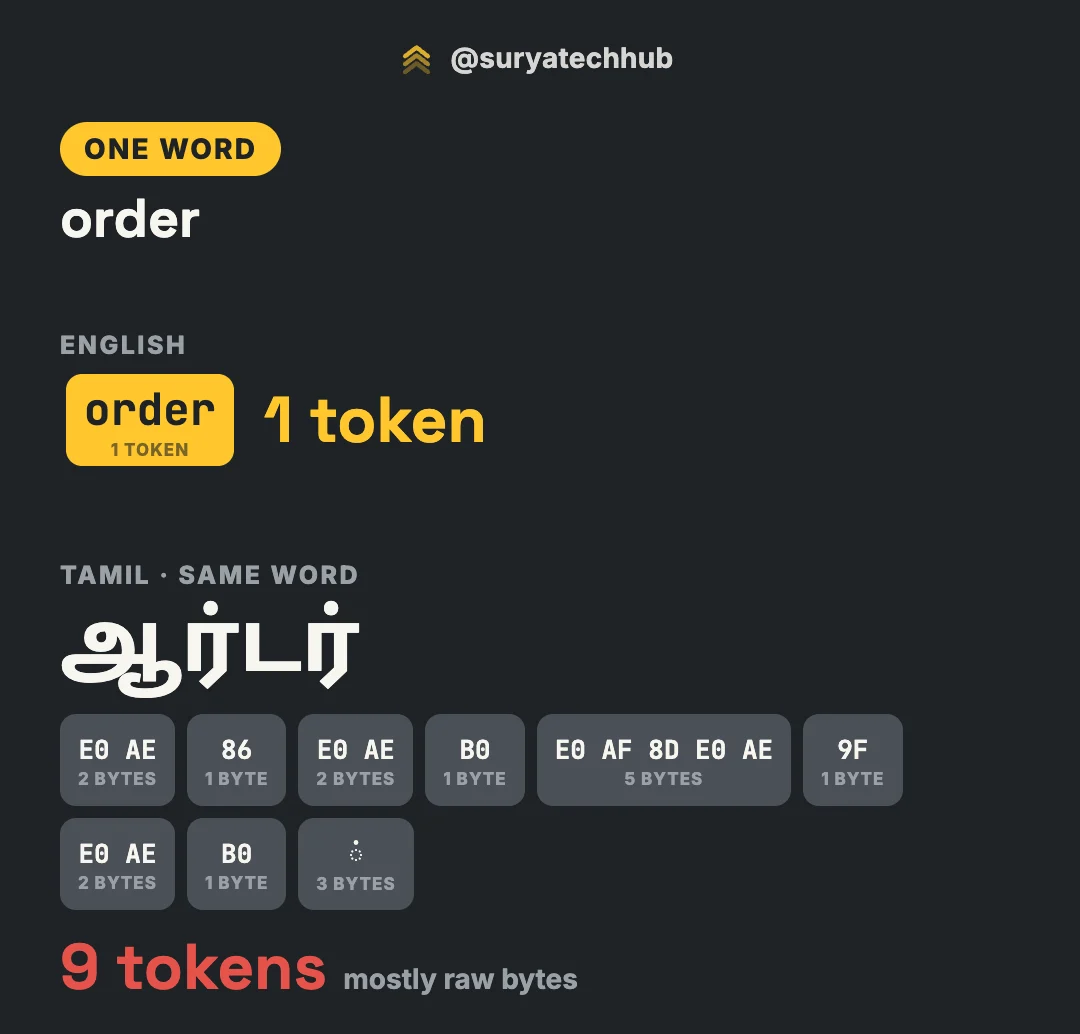
Three things cause this:
- The vocabulary is fixed before the model is trained. A BPE tokenizer learns about 100,000 pieces (100,277 for
cl100k_base) by merging the byte sequences that appear most often in its training text. - That text is mostly English. Common English words like
order,statusandrefundbecame single pieces. Tamil was rare, so most Tamil words never got a piece. - Anything without a piece is left as raw bytes. GPT tokenizers work on UTF-8 bytes. Every Tamil letter is 3 bytes (
ஆ=E0 AE 86), against 1 byte for an English letter (o=6F). The 6 letters of ஆர்டர் make 18 bytes, which end up as 9 tokens.
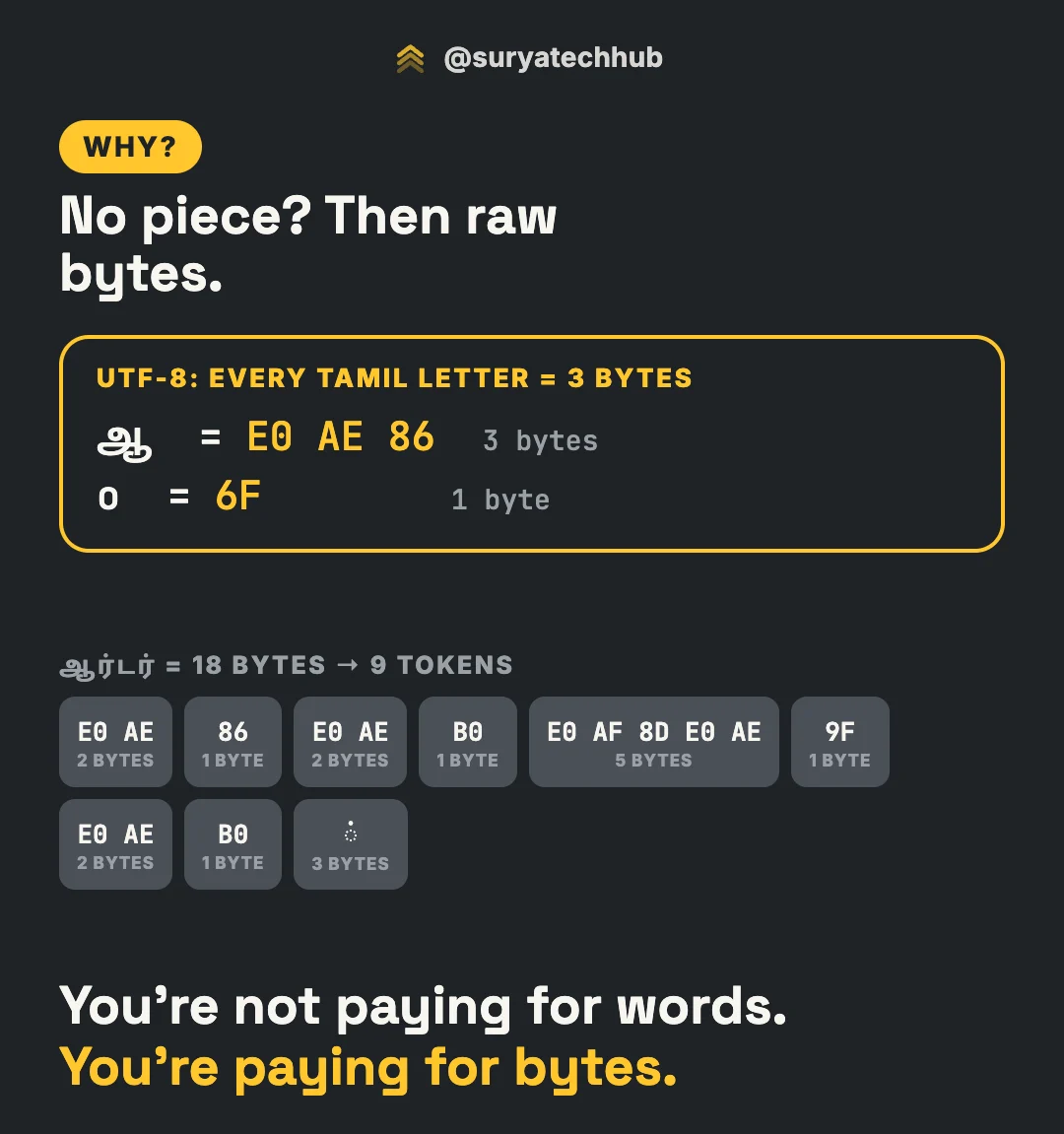
So you’re not paying for words. You’re paying for bytes.
This isn’t just one sentence. On a long text, the UN Declaration of Human Rights (the same text in each language), GPT-4 needs 9.8× as many tokens for Tamil as for English. A NeurIPS 2023 study across 2,000 sentences found Tamil at 7.65× on the same tokenizer (Petrov et al.).
Where the cost really is
Your bill isn’t simply 7× higher, and it helps to be precise about why:
- The system prompt is usually English, so it costs the same for every user, whatever language they write in.
- The extra is in the user’s message and the bot’s reply. The reply is the expensive part, because output tokens are priced higher than input on GPT-4, GPT-4o and Claude.
A typical reply on GPT-4:
| Reply | GPT-4 tokens |
|---|---|
| English: “Your order has been shipped. It will reach you tomorrow by 6 PM.” | 16 |
| Tamil: “உங்கள் ஆர்டர் அனுப்பப்பட்டது. நாளை மாலை 6 மணிக்குள் உங்களுக்கு வந்து சேரும்.” | 101 |
| Telugu | 100 |
| Hindi | 71 |
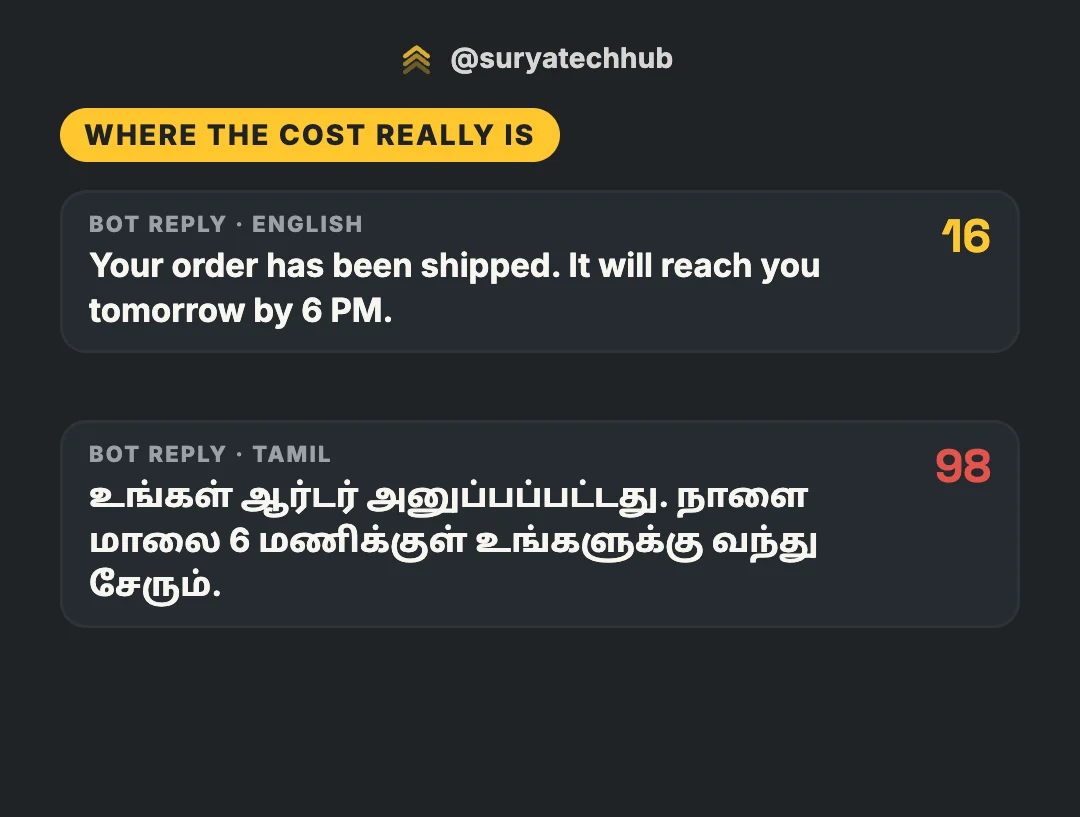
Three bugs only your regional users see
1. max_tokens cuts the reply mid-word
You tune max_tokens on English replies. The same limit stops the Tamil reply partway through. Below is a scaled demo: the cap is the English reply’s 16 tokens, and the Tamil text is the real decode of the Tamil reply’s first 16 GPT-4 tokens. It stops in the middle of a letter.
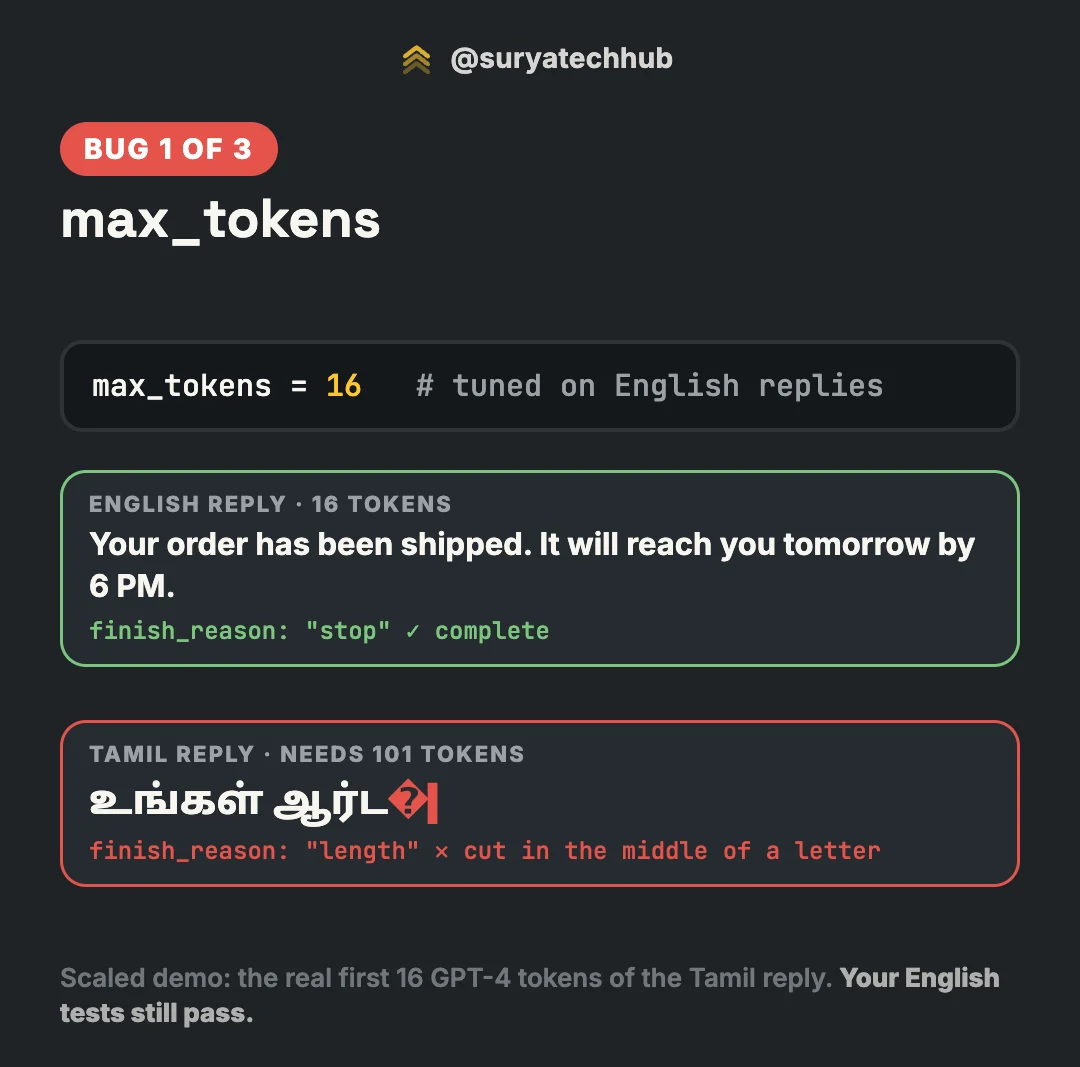
Your English tests pass, and only Tamil users see broken answers. Always check finish_reason (OpenAI) or stop_reason (Claude) for a length stop.
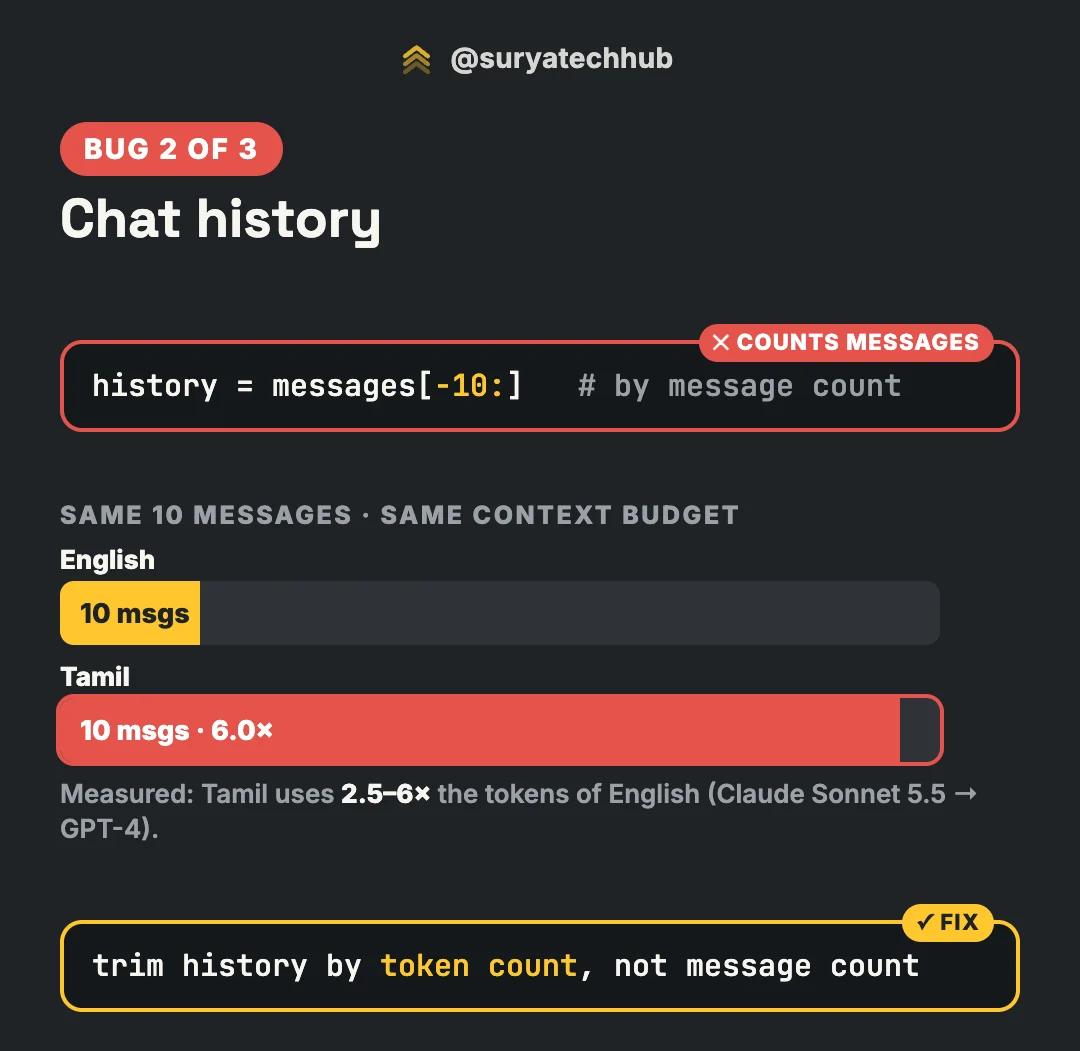
2. Chat history limited by message count
messages[-10:] keeps ten messages, but ten Tamil messages take 2.5–6× the tokens of ten English ones. That’s the range I measured, from Claude Sonnet 5.5 to GPT-4. The bot runs out of context, or out of budget, much sooner for regional users. Trim history by token count, not message count.
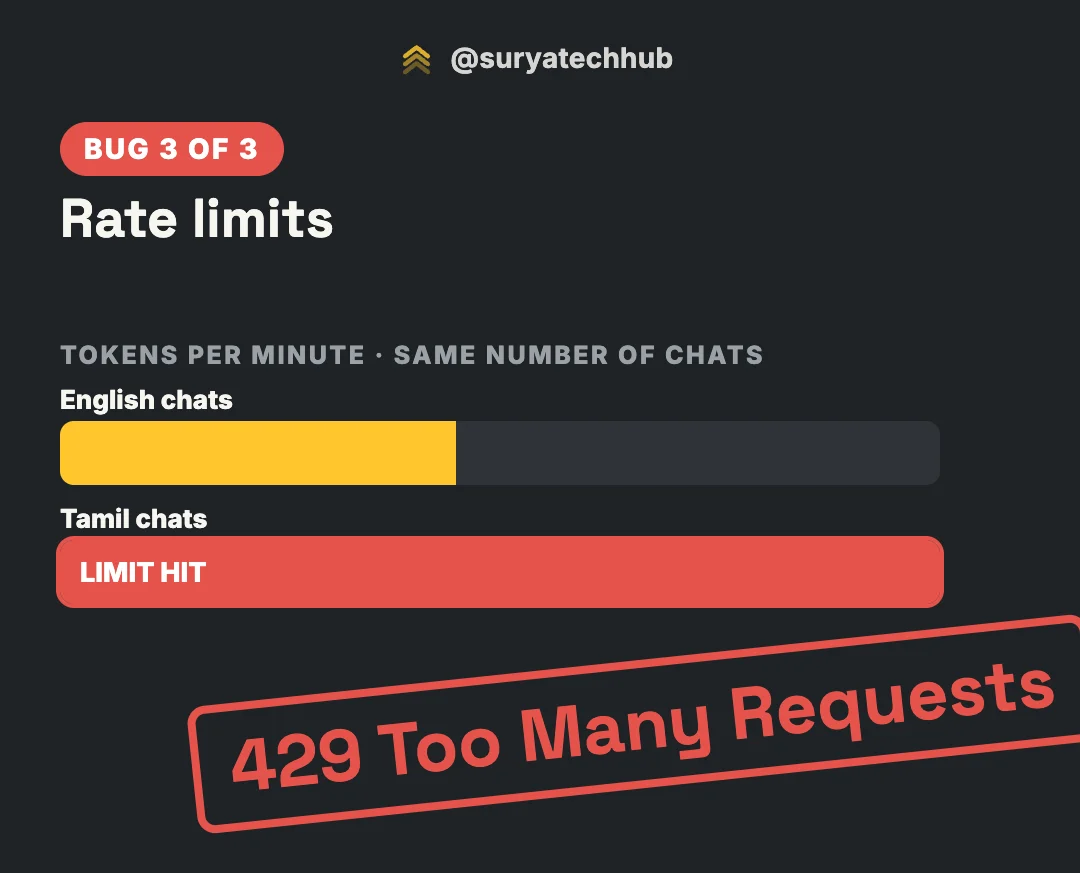
3. Rate limits are counted in tokens
Providers limit tokens per minute (Claude, for example, has separate input- and output-token-per-minute limits). The same number of Tamil chats burns through the limit several times faster, so your Tamil traffic gets the 429 Too Many Requests first.
Newer models: better, not fixed
GPT-4o doubled the vocabulary to 200,019 pieces (o200k_base), with far more pieces for Indian scripts. The same question:
| Language | GPT-4 | GPT-4o |
|---|---|---|
| English | 5 | 5 |
| Hindi | 18 | 8 |
| Tamil | 31 | 9 |
| Telugu | 35 | 9 |
Claude’s tokenizer isn’t public, so I counted with Anthropic’s count_tokens API on Claude Sonnet 5.5:
| Language | Question | × English | Bot reply | × English |
|---|---|---|---|---|
| English | 6 | 1× | 26 | 1× |
| Hindi | 18 | 3.0× | 50 | 1.9× |
| Tamil | 21 | 3.5× | 66 | 2.5× |
| Telugu | 25 | 4.2× | 54 | 2.1× |
On the long UN Declaration text, Claude Sonnet 5.5 is 3.7× for Tamil. Short counts can be off by ±1 because I subtracted the API’s message wrapper. Claude also splits English into more tokens than GPT does, so compare the multiples across vendors, not the raw counts.
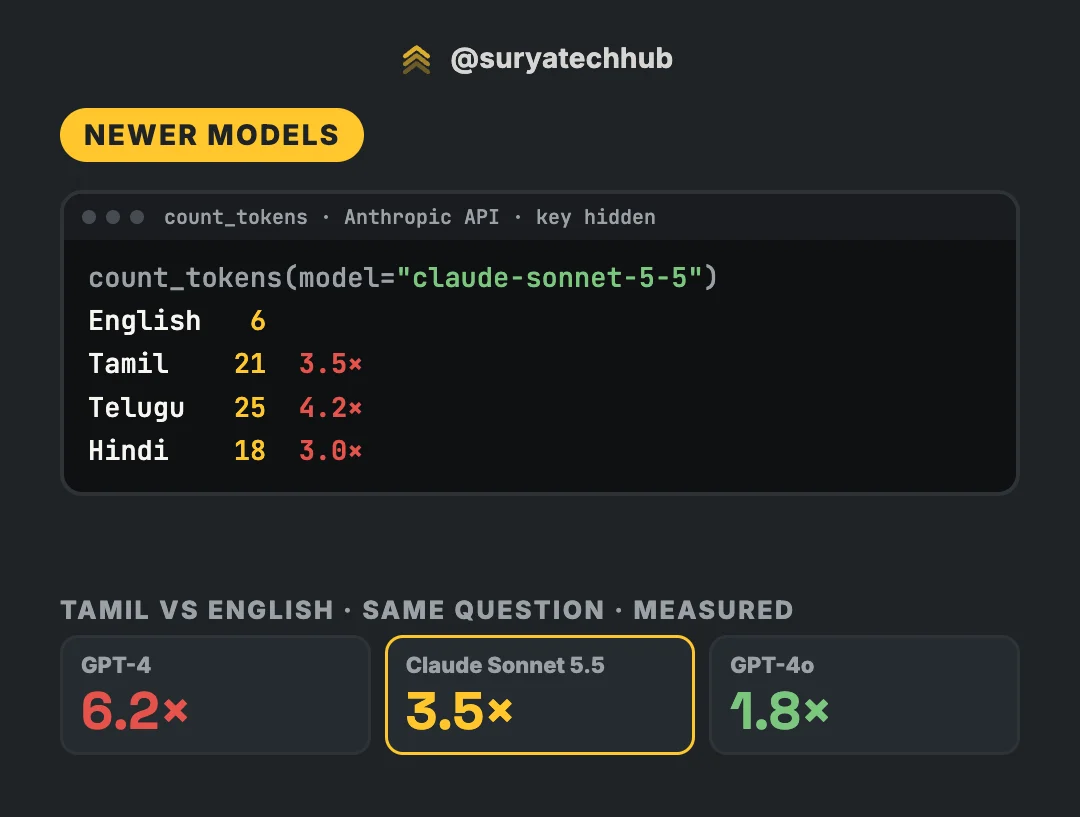
For the same question in Tamil: GPT-4 is 6.2×, Claude Sonnet 5.5 3.5×, GPT-4o 1.8×.
What to do about it
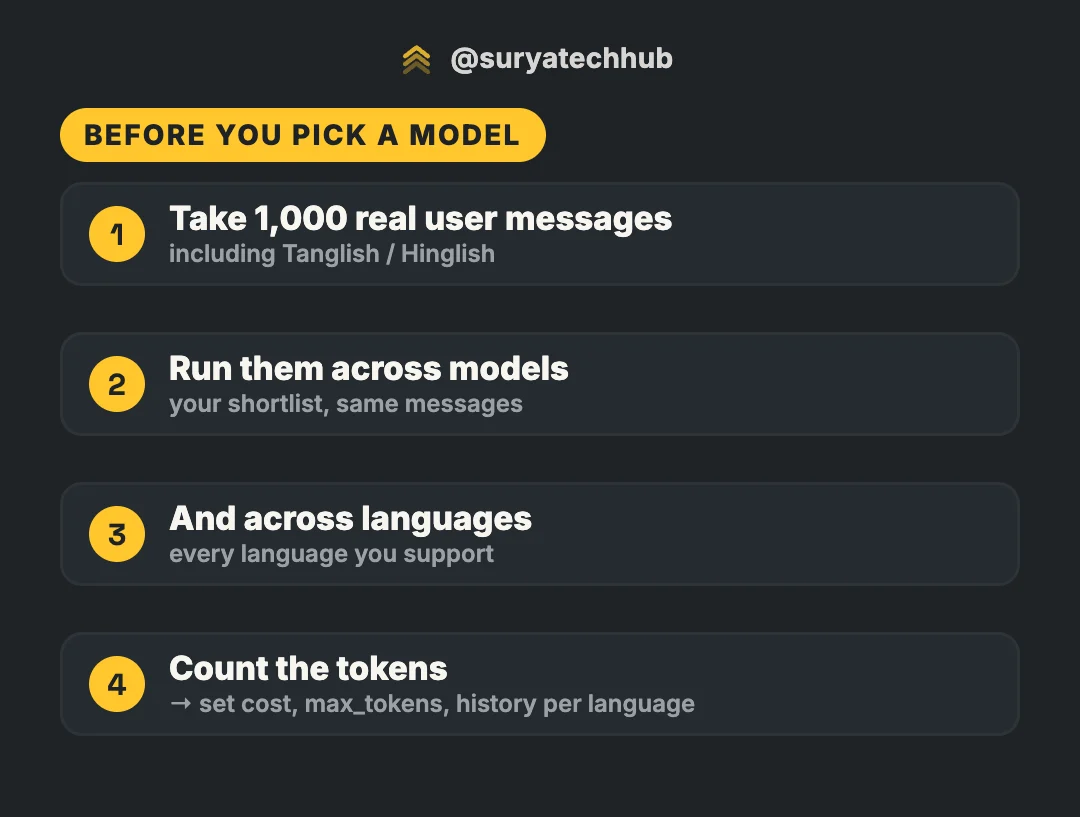
- Measure on real messages. Take about 1,000 real user messages per language, including Tanglish and Hinglish, and count tokens on every model on your shortlist. The ratio depends on the text, so don’t plan from someone else’s number (including mine).
- Set budgets per language: cost estimates,
max_tokens, history trimming and rate-limit headroom. - Know the options and their trade-offs:
- Reply in the script the user typed. Many users write Tanglish: “En order enga iruku?” is 7 tokens on GPT-4, almost the same as English.
- Pick a tokenizer that’s good at Indian scripts. Indic-first models such as Sarvam-1 narrow the gap further (1.5× for Tamil on the UN text, against GPT-4o’s 2.4×). Check answer quality on your tasks too, not just tokens.
- Translate to English first. It saves tokens but adds a call and latency, and can lose meaning.
The tests: run them yourself
The texts are the ones in the tables above. The long-text test uses the UN Declaration of Human Rights in Unicode XML from github.com/eric-muller/udhr.
- where.py: “Where is my order?” on GPT-4 and GPT-4o (
pip install tiktoken) - reply.py: the bot reply, plus the
max_tokenscut - count.py: the UN Declaration across 8 tokenizers (
tiktokenplus Hugging Facetransformers). Pass the folder holding theudhr_<lang>.xmlfiles. - claude_count.py: the Claude count through
count_tokens(needs an API key and a credit balance; the counting itself is free). It expects the UDHR files in audhr/folder next to it. - claude-sonnet-5-5-counts.txt: my Claude results
Long text (UN Declaration), tokens × English:
| Tokenizer | Tamil | Hindi | Telugu |
|---|---|---|---|
GPT-4 (cl100k_base) |
9.8× | 5.7× | 10.0× |
| Claude Sonnet 5.5 | 3.7× | 2.6× | 3.0× |
GPT-4o (o200k_base) |
2.4× | 1.7× | 2.6× |
| Gemma 3 | 1.8× | 1.4× | 2.4× |
| Sarvam-1 | 1.5× | 1.35× | 1.8× |
The English and Tamil files have the same 60 paragraphs. The other translations differ slightly in length, so treat their ratios as approximate.
Further reading:
- Petrov et al., “Language Model Tokenizers Introduce Unfairness Between Languages”, NeurIPS 2023: arxiv.org/abs/2305.15425
- Ahia et al., “Do All Languages Cost the Same?”, EMNLP 2023: arxiv.org/abs/2305.13707
- Anthropic, token counting: platform.claude.com/docs/en/build-with-claude/token-counting